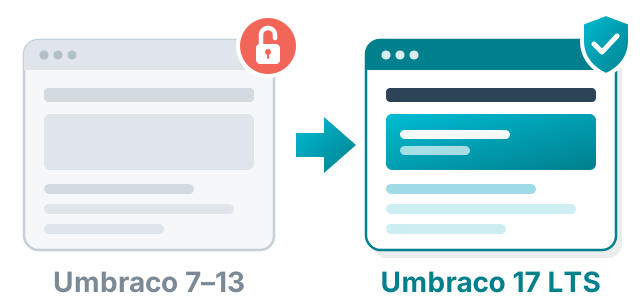
Yes, if your site runs Umbraco 13 or older. Umbraco 13 gets no security fixes from 14 December 2026, and versions 7 to 12 already get none. AI now finds security flaws faster than ever, and when a critical one turns up, only supported versions get the fix. Umbraco 17 LTS (long-term support) is supported until 27 November 2028.
From 10 November 2026, Microsoft's .NET 8, which Umbraco 13 runs on, gets no security fixes. Umbraco 13 follows on 14 December 2026, and any weakness found after that stays open. UK Cyber Essentials requires unsupported software to be removed or isolated, so the certificate is at risk too.
Umbraco 13 can't run any of Umbraco's AI tools, for editors or for developers. The site stays closed to them until it moves to Umbraco 17.
Packages are add-ons that give Umbraco extra features, such as forms, search or SEO tools. Their authors are dropping old Umbraco versions, so fixes stop reaching your site.
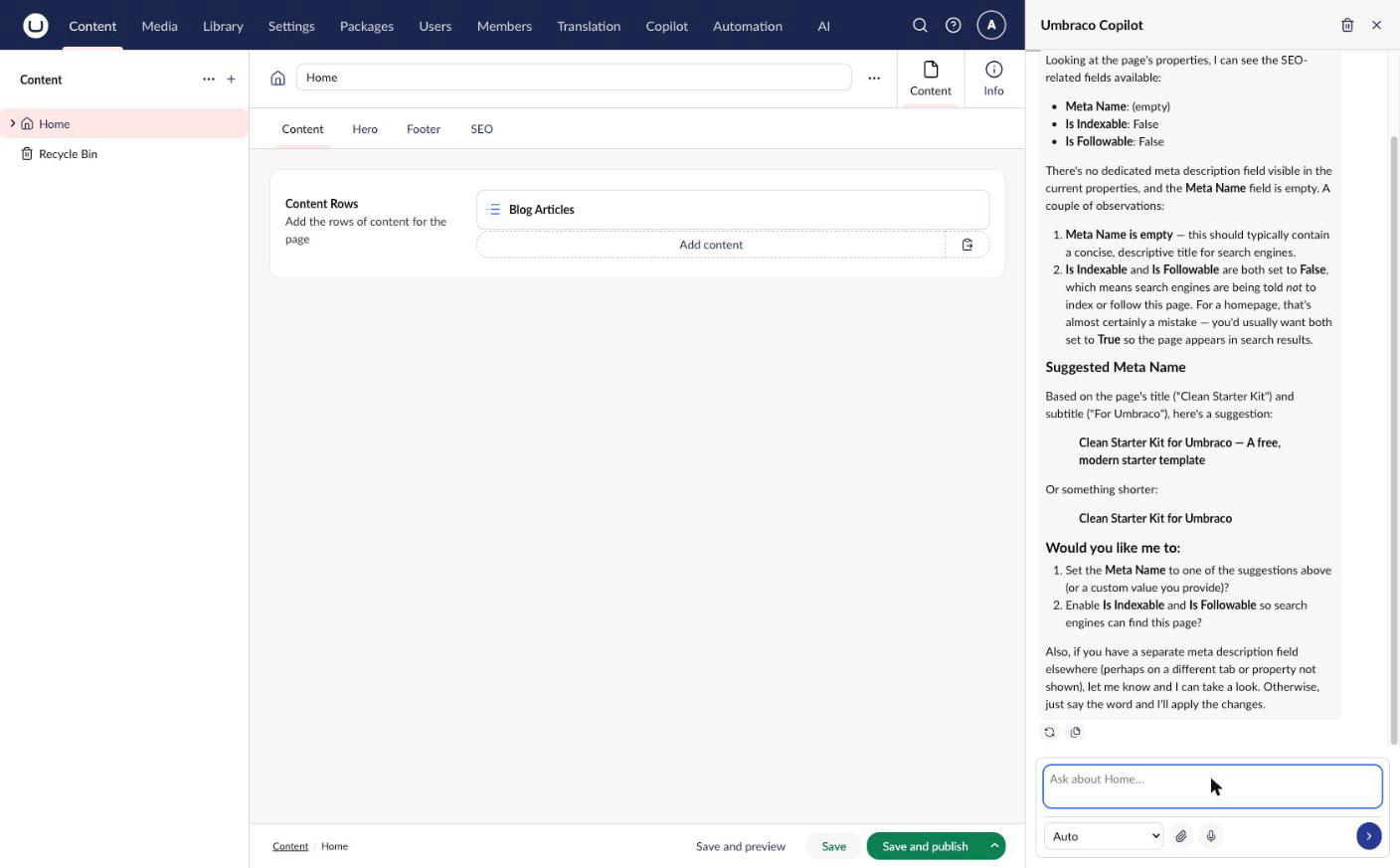
With Umbraco AI, editors get one-click writing help and a Copilot. Developers get an MCP server and Agent Skills for AI coding tools, and an MCP server for editors is announced. All are add-ons needing an AI provider, set-up and tuning: a separate project. The upgrade opens the door.
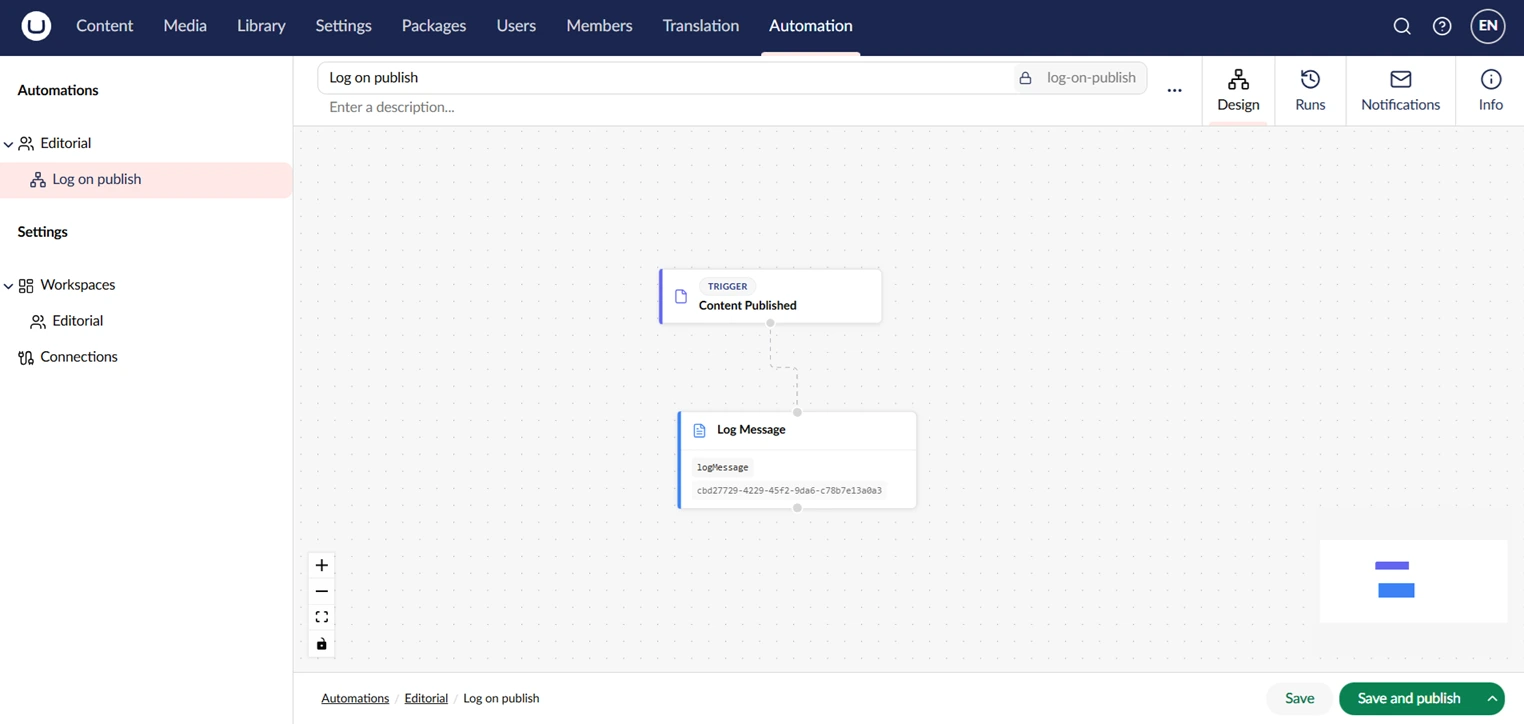
Umbraco Automate runs actions when a form is submitted or content changes. You set it up by drag and drop in the backoffice, where your team edits the site. Steps can use AI, with a person reviewing the result.
Umbraco rebuilt the backoffice on a modern front-end framework. It is much faster, and much easier to extend with your own tools, such as dashboards for your team.
Not sure where your site stands?
Book a 30-minute call. The free audit then gives you a fixed price within 3 business days.
The site looks and works the same. Page addresses (URLs) stay as they are, and so do SEO settings such as page titles and descriptions.
Content and page structure stay. The backoffice looks different but works the same way. For 30 days after go-live, we help your editors with any problem in it.
Custom backoffice extensions are rebuilt for the new backoffice, and the code moves to .NET 10. We took our own commercial product, ByteEditor, through the Umbraco 13 to 17 backoffice rewrite.
We check every package: keep it, swap it for a better-maintained one, or replace it with something now built into Umbraco. We compare your hosting with Umbraco Cloud, Umbraco's own hosting, and Azure. If yours is fine, we say so.
Supported until 14 December 2026. We upgrade it straight to Umbraco 17, usually with the Standard package.
Out of support. We take the site to Umbraco 13 first, usually a small step, then on to 17 in the same project. Usually the Standard package.
Out of support since 24 February 2025. The step to 13 is the big one, because the code moves from Microsoft's older .NET Framework to modern .NET. Then on to 17. Usually the Complex package.
Out of support since 30 September 2023. We go from 7 to 8, 13 and then 17, step by step, keeping your content. A rebuild on 17 is an option, not a must. We quote after the free audit, which shows which route costs less.
Tell us what the site does, who edits it and what worries you. You leave knowing roughly what the upgrade involves.
We review your page types, packages and custom code. You get a verdict on each package, your hosting options and a fixed quote, with no obligation.
We upgrade a copy of your site, never the live one. AI tools speed up the code changes, and an engineer reviews every change.
We compare every page before and after the upgrade, not a sample: content, layout and SEO tags. An engineer reviews each difference.
Your team tries the upgraded copy before go-live: editing, forms, anything you rely on. This is user acceptance testing, and go-live waits for your sign-off.
Editors pause changes briefly, then the site goes live. For 30 days we fix anything the upgrade broke, replying within one business day.
Most Umbraco upgrades cost €3,990–13,900, as a fixed price agreed after the free readiness audit and before any work starts. Custom code, packages that need replacing, integrations, and several sites or languages push the price up. Both upgrade packages include 30 days' cover after go-live.
| Package | Price | Time | Includes |
|---|---|---|---|
| Readiness audit | Free | 3 business days | A review of your site and a fixed quote |
| Standard upgrade | From €3,990 | 2–3 weeks | The full upgrade to Umbraco 17 |
| Complex upgrade | €6,900–13,900 | 4–6 weeks | The same, plus custom backoffice extensions, integrations, several sites or languages |
The audit starts with a free 30-minute call.
For SoftwareDanmark, a Danish digital agency and long-term partner, we took a client's corporate site from Umbraco 8 to 13, then to 17. The 13 to 17 step took 3 weeks, with 0 issues in the 30 days after go-live. We still support the site.
We upgraded the international NGO's website from Umbraco 13 to 17 on Umbraco Cloud in 3 weeks, with 0 issues after go-live. We support the site, and Umbraco Cloud now applies security patches automatically.

SoftwareDanmark has worked together with these guys for several years now, and they are always 100% focused and dedicated. Smooth major upgrade from Umbraco v13 to v17 with no issues. Fast, professional, and reliable ongoing support for our Umbraco-based corporate site. Great communication and deep technical Umbraco CMS expertise.
We have been working with ByteAnt for a few years on an ongoing basis. Valeriy and the team have always delivered high quality solutions and in good time too! We could not have asked for a better team supporting our Umbraco-based website.

Ready to plan your upgrade?
Book a 30-minute call to start your free audit.
Usually 2–3 weeks for a Standard upgrade and 4–6 weeks for a Complex one, after an audit of 3 business days. Our upgrades for World Diabetes Foundation and a SoftwareDanmark client each took 3 weeks, and Goode Sport's took 2. Your audit says which timeline fits your site.
The audit is free, a Standard upgrade costs from €3,990 and a Complex one €6,900–13,900. Sites on Umbraco 10 to 13 usually need Standard and Umbraco 8 sites Complex; Umbraco 7 sites are quoted after the audit. The quote is fixed, so the price doesn't grow once work starts.
Yes, and there's no obligation to go ahead with us. You get a verdict on every package (keep, replace or drop), your hosting options, what your custom code needs and a fixed quote. If you are not sure which Umbraco version you run, the audit tells you that too.
Because a critical flaw can surface at any time, and only supported versions get a fix. In October 2026, AI tools helped uncover PHP2Shell, two critical flaws in PHP, a language many websites run on, which had gone unnoticed for years. Supported PHP versions were patched the next day, while end-of-life versions such as 7.4 and 8.1 got no official fix. Umbraco runs on .NET, not PHP, but the lesson holds: moving to Umbraco 17 LTS now keeps your site patchable.
Umbraco 13 is the next to go, on 14 December 2026. The dates, from Umbraco's long-term support page:
LTS means long-term support: a version that gets fixes and security patches for three years. Umbraco 17 is the current LTS, while 18 is a short-term release with one year of support, so moving to 18 means another major upgrade within a year. The next LTS, Umbraco 21, is planned for 9 December 2027.
An update stays within one major version, for example a newer Umbraco 13 release, and is usually small. An upgrade moves to a new major version, such as 13 to 17, and changes the backoffice and parts of the code. That makes it a project, with testing and a planned go-live.
No, it keeps running. What stops is security fixes, so any weakness found after that date stays open and the risk grows month by month rather than overnight.
Yes, in one project that passes through Umbraco 13 on the way: usually the Standard package from 10, and Complex from 8. Stopping at 10 or 13 means paying for two upgrades instead of one.
No. We can take the site through Umbraco 8 and 13 to 17 step by step, keeping your content. A rebuild on 17 is worth considering if you want a new design anyway, and we quote either route after the free audit.
No. The upgrade makes it possible, because Umbraco 13 can't run it, but setting it up is a separate project. Umbraco AI connects to a provider you choose, such as OpenAI or Azure OpenAI, and needs connections and profiles set up and tuned for your content.
Three layers of checks. Automated comparisons of every page cover content, layout and SEO tags such as titles, canonical links and structured data, and browser tests cover key journeys such as forms and search. An engineer reviews every result before your team tests the upgraded copy.
Neither should happen. We upgrade a copy, so the live site stays online, and at go-live editors pause changes for a short content freeze. Your URLs don't change, and our checks cover titles, descriptions and other SEO tags.
Partly. Umbraco Cloud applies minor and patch updates automatically by default, but a major upgrade such as 13 to 17 is manual work. That's the part we do, as we did for World Diabetes Foundation and Goode Sport.
For 30 days after go-live we fix anything the upgrade broke and help your editors, replying within one business day. New features and content changes aren't included; for those, our support plan can take over.
Yes, with our support plan: €300 a month for a day of work, with no minimum term. We apply every update still released for your version, watch the site and fix problems while the upgrade is planned. Once Umbraco's support has ended there are no new official patches, so the plan buys time but doesn't replace the upgrade.
Yes, under rules that protect your data. We use Claude on a business plan whose terms exclude training on customer data. AI works on a local copy of your site, never on your live website. Changes reach test, staging and live through our normal deployment, after an engineer has reviewed them. Passwords and keys are kept out of AI's reach, and you own all the code. If your policy restricts AI, we agree the rules with you before we start.
Book a call: